
Finding Home and Auto Insurance Providers Near Me: A Local Guide
Finding Home and Auto Insurance Providers Near Me is about identifying local agents and national carriers that offer bundled coverage for your residence and vehicles within your specific zip code. This process ensures you secure localized discounts, meet state-specific mandates, and often results in a multi-policy discount that lowers your overall premium.
- •Why Proximity Matters When Finding Home and Auto Insurance Providers Near Me
- •The Hidden Logistics of Finding Home and Auto Insurance Providers Near Me
- •The Great Misconception: Is Online Always Cheaper?
- •The Power of the Bundle
- •How Local Underwriting Affects Your Wallet
- •Vetting Your Local Options
- •The Logistics of Making the Move
- •Evaluating Claims Reputation Locally
- •The Future of Local Insurance
- •Final Reflections on Your Local Search
- ◦Frequently Asked Questions
We’ve noticed that most people start this journey with a quick search, but the real value lies in understanding how proximity changes your risk profile. By looking beyond the first page of results, we’re going to help you uncover regional players and localized savings that the big algorithms often overlook, giving you a much clearer picture of what “local” coverage actually means for your wallet.
Why Proximity Matters When Finding Home and Auto Insurance Providers Near Me
When we sit down to look at how insurance rates are actually calculated, it’s easy to think it’s all just cold math done by a computer in a skyscraper hundreds of miles away. But the truth is much more grounded. Proximity is a massive factor in underwriting. When you’re looking for coverage in your specific neighborhood, you’re essentially asking a company to bet on the safety of your street.
We’ve found that local providers often have a better “boots on the ground” understanding of your area’s specific quirks. For example, a national carrier might see your entire city as a moderate flood risk, but a local agent knows that your specific block sits on higher ground and hasn’t seen a puddle in forty years. That local nuance can be the difference between a standard rate and a preferred rate.
Beyond the math, there’s the human element. There is something genuinely reassuring about knowing you can drive ten minutes down the road and sit across a desk from the person managing your policies. If a tree falls on your garage or a fender-bender happens at the local grocery store, having a local point of contact who knows the local repair shops and contractors can streamline the recovery process in a way a 1-800 number simply can’t.
The Hidden Logistics of Finding Home and Auto Insurance Providers Near Me
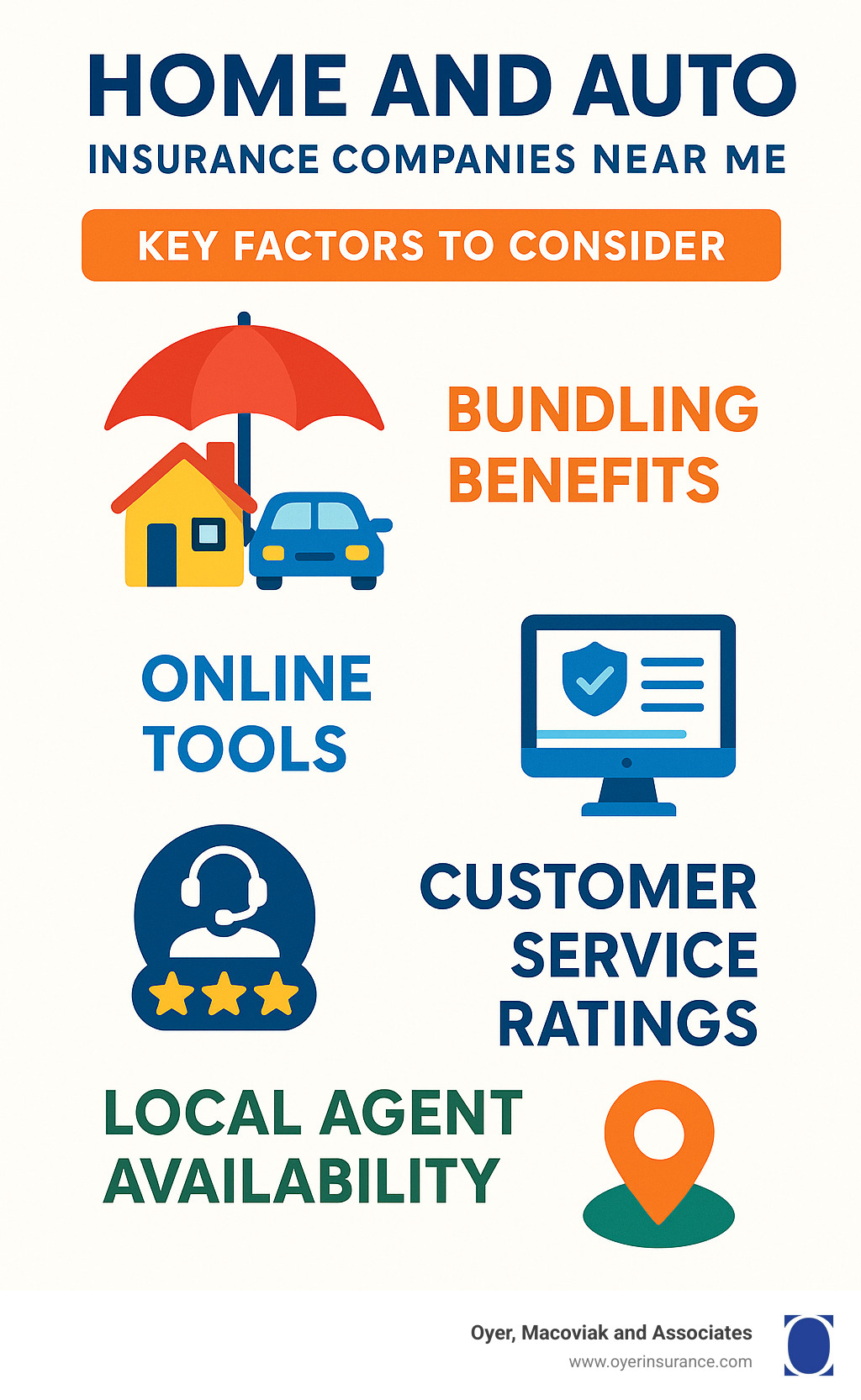

The “near me” part of your search triggers a complex set of digital gears. Search engines use your IP address or GPS data to filter results, but insurance companies use your zip code to determine everything from your crime-rate score to the likelihood of a hail storm. It’s a localized game of probability.
When we analyze the way home and auto bundles are priced, we see that regionality plays a starring role. Some companies specialize in the Midwest because they’ve mastered the art of pricing for tornadoes and snow. Others stick to the coast, focusing on hurricane preparedness. Finding the provider that “specializes” in your specific geography is often the secret to finding the lowest premiums.
It is also worth noting that state laws vary wildly. If you live near a state border, a provider “near you” might actually be governed by entirely different regulations if they are just across the line. We always suggest double-checking that the local office you find is fully licensed and experienced in your specific state’s insurance statutes, as things like “no-fault” auto laws or “valued policy” home laws can change the entire structure of your coverage.
The Great Misconception: Is Online Always Cheaper?
There is a widespread belief that cutting out the middleman—the local agent—and buying directly from a giant website will always save you money. The logic seems sound: no office rent to pay, no agent commissions, just pure, direct-to-consumer savings. But based on our observations, this is one of the biggest myths in the industry.
In reality, direct-to-consumer brands spend billions on advertising to get your attention. Those “savings” are often offset by massive marketing budgets. Meanwhile, a local independent agent might have access to “Regional Mutuals.” These are smaller insurance companies that don’t advertise on TV and only sell through local agents. Because they don’t have the overhead of a national brand, their rates for a identifying the best insurance provider for auto can be significantly lower for homeowners with clean records.
The “aha” moment for many of our readers comes when they realize that an agent isn’t just a salesperson; they are a professional shopper. An independent agent can run your details through twenty different systems at once. If you do it yourself online, you’re only seeing one company’s version of the truth. Sometimes, the “human” route is actually the more efficient one.
The Power of the Bundle
If you’re looking for both home and auto coverage, you are the “ideal” customer for most insurance companies. They love “sticky” customers—people who have multiple ties to the company. Because of this, the multi-policy discount is usually the single largest discount you can get.
We’ve seen cases where adding a small life insurance policy or a renters policy actually lowered the total cost of the bill because it triggered a higher tier of bundling discounts. It sounds counterintuitive, but buying more can sometimes cost you less. When you find providers near you, ask them to “staircase” the quotes. See what happens when you add an umbrella policy or jewelry floater. The results might surprise you.
| Provider Type | Best For… | Key Advantage |
|---|---|---|
| Captive Agent | Brand Loyalty | Deep knowledge of one company’s specific perks. |
| Independent Agent | Comparison Shopping | Access to multiple carriers and regional mutuals. |
| Direct Online | Speed & Tech | 24/7 digital management and instant ID cards. |
| Regional Mutual | Niche Geography | Rates tailored specifically to local weather/risks. |
How Local Underwriting Affects Your Wallet
An overlooked detail our team often encounters is the “Protection Class” rating of a home. This is a score from 1 to 10 that reflects how prepared your local community is for a fire. It looks at how far you are from the nearest fire station and whether there’s a fire hydrant within a certain number of feet from your front door.
National companies use databases to find this, but those databases aren’t always updated. A local provider often knows if a new fire station opened up three blocks away last year. If your insurance company thinks you’re a Class 9 but you’re actually a Class 3, you’re overpaying by hundreds of dollars. This is where “Finding Home and Auto Insurance Providers Near Me” becomes a financial strategy rather than just a search query.
The same applies to auto insurance. Local agents know which intersections are “accident magnets” and which neighborhoods are seeing a spike in catalytic converter thefts. They can advise you on whether to increase your comprehensive coverage or if you can afford to raise your deductible based on local trends we’ve observed over the years.
Vetting Your Local Options
Once you have a list of names, the real work begins. We recommend looking past the star ratings on Google. (Let’s be honest, most people only leave insurance reviews when they’re angry about a claim denial, which might actually be justified based on their policy). Instead, look for “years in business” and “community involvement.”
An agent who sponsors the local Little League team or has been in the same brick-and-mortar office for twenty years has a reputation to uphold. They can’t afford to give bad advice because they’ll see you at the grocery store. That social contract is a powerful layer of consumer protection that you don’t get with a chatbot.
Check their credentials. Are they a “Certified Insurance Counselor” (CIC) or a “Chartered Property Casualty Underwriter” (CPCU)? These designations mean they’ve gone through rigorous extra training. It’s the difference between a general practitioner and a specialist. If your situation is complex—maybe you have a home-based business or a teenage driver—you want the specialist.
The Logistics of Making the Move
If you find a better deal locally, don’t be afraid of the paperwork. Many people stick with mediocre insurance for years because they think switching is a nightmare. It’s actually quite simple. Once you have your new policy in hand, you just send a cancellation notice to your old carrier.
We’ve put together some thoughts on how to switch auto insurance providers that can help you time the move so you don’t end up with a gap in coverage. The most important thing is to ensure your new home insurance is coordinated with your mortgage escrow account if you have one. You don’t want your bank sending checks to a company you no longer use.
Most local agents will actually handle the “breakup” for you. They’ll provide the forms and even help you get your pro-rated refund from your old provider. It’s in their best interest to make the transition as seamless as possible so you start the relationship on a high note.
Evaluating Claims Reputation Locally
The true value of insurance isn’t the piece of paper you put in your glove box; it’s the check you receive when things go wrong. When researching providers near you, try to find out who their local adjusters are. Some companies use “independent adjusters” who fly in from out of state after a storm. Others have local staff adjusters who live in your city.
In our experience, staff adjusters who live in the area tend to be more reasonable because they understand the local cost of labor and materials. They know that a roof replacement in your town costs more than it does three states away. They aren’t just looking at a national average; they’re looking at the reality of your local economy.
Ask the agent: “If I have a claim, do I call you or a 1-800 number?” While almost every company has a 24-hour claims line, the best agents will tell you to call them first. They can give you a “sanity check” on whether the damage is worth filing a claim for (considering your deductible and potential rate hikes) and can recommend local contractors they trust.
The Future of Local Insurance
As we look toward the next few years, the way we find local insurance is changing. Telematics—those little plug-in devices or apps that track your driving—are becoming standard. This means your “local” rate will be even more personalized to your specific commute. If you only drive three miles to work on quiet backroads, your rate will reflect that, regardless of how the rest of the city drives.
Smart home technology is also entering the local insurance space. Some providers near you might offer discounts for installing water leak sensors or smart fire alarms. These devices can prevent a small leak from becoming a $50,000 claim, and insurers are increasingly willing to subsidize the cost of that tech to keep their local loss ratios low.
We are also seeing a resurgence in the “boutique” agency model. After a decade of everything moving toward giant, faceless digital platforms, many people are craving that personal touch again. The “Finding Home and Auto Insurance Providers Near Me” search is often the first step back toward a more human-centric way of managing risk.
Final Reflections on Your Local Search
Finding the right insurance isn’t a “one and done” task. It’s a relationship that should evolve as your life does. Maybe you’ve finished your basement, or perhaps your old sedan has finally been replaced by a new SUV. Every one of these changes is a reason to check back in with your local provider.
We often think of insurance as a burden—a monthly bill that we hope we never have to use. But when you find a provider who is truly “near you,” both geographically and in terms of their understanding of your needs, it stops being a chore and starts being a foundation. It’s about building a safety net that is woven specifically for the place you call home.
There’s a certain peace of mind that comes from knowing that if the worst happens, you aren’t just a policy number in a database. You’re a neighbor. And in an increasingly digital world, that local connection might just be the most valuable coverage you can buy.
Frequently Asked Questions
Is it always cheaper to bundle home and auto?
In about 95% of cases we’ve studied, yes. The discount usually ranges from 10% to 25% off both premiums. However, if you have a very high-risk car (like a supercar) or a very high-risk home (like one on a cliffside), sometimes separate specialty carriers are more cost-effective.
Do I have to wait for my current policy to expire to switch?
No, you can switch at any time. Your current insurer is legally required to refund you for the “unearned premium”—the portion of the policy you’ve paid for but haven’t used yet.
What is the benefit of a local independent agent over a big brand?
An independent agent can shop your profile across multiple companies, whereas a big brand agent (captive agent) can only offer you products from that one specific company. Independence usually offers more choices and more competitive pricing.